What is the European counterpart to a T1 line
| European driving licence | |
|---|---|
  Examples of the European driving licence issued in Federal republic of germany and Kingdom of norway. Licences issued in Iceland, Liechtenstein and Norway do not feature the Eu flag. | |
| Issued past |  Member states of the European Economic Area[a] Member states of the European Economic Area[a] |
| First issued | 29 July 1991 |
| Purpose | Access to unified driving licence in any of the EEA member states |
| Valid in | The European Economic Area |
| Eligibility | EEA residency |
The European driving licence is a driving licence issued by the fellow member states of the European Economical Expanse (EEA); all 27 EU member states and three EFTA member states; Iceland, Principality of liechtenstein and Norway, which give shared features the various driving licence styles formerly in use. It is credit card-style with a photo and a microchip. They were introduced to replace the 110 dissimilar plastic and paper driving licences of the 300 million drivers in the EEA. The primary objective of the licence is to reduce the risk of fraud.
A driving licence issued by a member state of the EEA is recognised throughout the EEA and tin can exist used as long as it is valid, the driver is old enough to drive a vehicle of the equivalent category, and the licence is not suspended or restricted and has not been revoked in the issuing country. If the holder of an EEA driving licence moves to another EEA state, the licence can exist exchanged for a driving licence from the new EEA country. Nevertheless, every bit all EEA driving licences are recognised throughout the EEA, information technology is usually non necessary to exchange it.[one]
The exception is for those property EEA driving licences issued in exchange for a non‑EEA licence. When holding a converted licence, i should non assume the licence can be exchanged when moving to another EEA land. This only applies when permanently relocating to a different EEA country. As a tourist, an EEA-licence issued in exchange of a non-EEA licence is recognised throughout the EEA.[1]
History [edit]
1980–1996 [edit]
The first stride to a European driving licence was taken on 4 December 1980, when the Council of Ministers adopted Council Directive 80/1263/EEC on the introduction of a Community driving licence, which established a Customs model national licence that guaranteed the mutual recognition by the Member States of national licences. It also established the practice of commutation of licences by holders moving from i Member Country to another.
1996–2013 [edit]


| Eu directive | |
 | |
| Title | Council Directive on driving licences |
|---|---|
| Fabricated by | Quango of the European Wedlock |
| Made under | Fine art. 75 TEC |
| Journal reference | L237, pp 1–24 |
| History | |
| Date fabricated | 29 July 1991 |
| Came into force | 24 Baronial 1991 |
| Implementation date | 1 July 1996 |
| Other legislation | |
| Replaces | Directive 80/1263/EEC |
| Replaced by | Directive 2006/126/EC |
| Repealed | |
On 29 July 1991, the Council of Ministers adopted the Council of the European Union Directive 91/439/EEC on driving licences. The directive required EU Fellow member States to prefer laws implementing the directive earlier i July 1994, which took upshot on i July 1996. Directive 80/1263/EEC was repealed on the same date.
Directive 91/439/EEC was incorporated into the EEA Agreement through Decision of the EEA Joint Committee No 7/94 of 21 March 1994,[2] and specified driving licence in the European Wedlock and the European Economic Area until its repeal on xix January 2013.
Provisions [edit]
The Council of the Eu Directive 91/439/EEC harmonised the categories of driving licences amid the Member States and established two Community driving licence models, one newspaper version and one plastic card version. It furthermore established an obligatory test of cognition (theory) and a test of skills and behaviour (practical) which had to be successfully passed before an individual is offered a driving licence. Information technology also required an applicant to meet the minimum standards of physical and mental fitness to drive. The directive specified the minimum ages for driving different types of vehicles, and established progressive access in categories A, C, and D, from lite vehicles to larger or more powerful vehicles. The directive stipulated that it is mandatory to have the normal residence in the Member State issuing the licence.[3]
Amendments [edit]
The Directive was substantially amended past nine directives and two acts of accession. The plastic card version of the Customs licence model, for example, was added to the Directive by Quango Directive 96/47/EC of 23 July 1996.[4]
Since 2013 [edit]
| European Marriage directive | |
| Text with EEA relevance | |
| | |
| Title | Directive of the European Parliament and of the Council on driving licences (Recast) |
|---|---|
| Fabricated past | European Parliament & Quango |
| Fabricated under | Art. 71 TEC |
| Periodical reference | L403, pp. 18–60 |
| History | |
| Date made | 30 December 2006 |
| Came into forcefulness | 19 January 2007 |
| Implementation date | nineteen January 2013 |
| Other legislation | |
| Replaces | Directive 91/439/EEC |
| Current legislation | |
In March 2006, the Council of Ministers adopted a Directive proposed by the European Committee to create a unmarried European driving licence to supervene upon the 110 dissimilar models in existence throughout the EU/EEA at the time.[5] [half dozen] The European Parliament adopted the Directive in December 2006.[7] Directive 2006/126/EEC was published in the Official Journal of the Eu on 30 December 2006.[8] Its provisions took event on nineteen January 2013; Directive 91/439/EEC was then concurrently repealed.
Provisions [edit]
The licence is a credit-card-style, single plastic-coated document, very difficult to counterfeit. The certificate is renewable every ten or 15 years depending on the member state. Several member states accept the option to include a microchip containing information about the carte holder on the card.
Some categories like C and D are issued for v years only. Subsequently expiration, a medical cheque-upwardly is necessary in order to renew the licence for another v years.
EEA relevance [edit]

The provisions of Directive 2006/126/EC mention that it has European Economic Area (EEA) relevance, meaning that its provisions employ to all 27 EU member states, as well as Iceland, Liechtenstein, and Kingdom of norway, through incorporation into the understanding on the EEA.[nine]
The Directive was incorporated into the EEA agreement through Decision of the EEA Joint committee No 29/2008 of 14 March 2008 alteration Annex Thirteen (Transport) to the EEA Agreement.[10] The Decision made some adaptions to the directive, notably: the distinguishing sign issuing the licence is encircled past an ellipse instead of being printed on the European flag, the words "driving licence" in Icelandic and Norwegian languages were added, and the words "European Communities model" were replaced past "EEA model".[ten]
Although Switzerland is a member country of EFTA, it is not a contracting party of EEA Agreement. Switzerland is instead linked to the EU by a serial of bilateral agreements and has generally adopted much of the harmonised EU legislation with regard to driving licences. Switzerland has used the EU arrangement of vehicle categories since the 2000s, and Swiss driving licences are EEA-mode credit-card licences.
Implementation [edit]
The directive stipulated that all 31 EEA members states must have adopted laws implementing the directive no after than 19 January 2011. Those laws took effect in all EEA members states on 19 January 2013. All licences issued before that date will become invalid past 2033.
Brexit [edit]
Directive 2006/126/EC applied to the United Kingdom until the transition period subsequently the UK withdrew from the Eu terminated on 31 December 2020, as European union law continued to employ to the U.k. during this period.[eleven]
From 1 January 2021, European licences are recognized past the United kingdom of great britain and northern ireland if the driving test was passed in an EU/EEA country, and can be used both if the holder is visiting or if residing in the Great britain. They tin can also exist exchanged for a UK driving licence.[12] [13]
Britain driving licences tin exist used when visiting European union/EEA countries with some exceptions.[14] [15] [16] International Driving Permits might be needed in some cases. Depending on which convention the land in question has ratified, a 1949 IDP (Geneva Convention on Route Traffic) might be required in some EEA countries, and a 1968 IDP (Vienna Convention on Road Traffic) in others. Nevertheless, none of the EEA countries currently require IDPs for visitors staying shorter than 12 months.[17]
Standard data field labelling [edit]
To help users of different languages to understand what each of the information fields on the licence contains, they are labelled with a number. A legend is supplied on the opposite of the bill of fare in the issuing potency'southward language.[18]
- surname
- other names[a]
- date of birth, place of birth[d]
- a) appointment of outcome, b) date of expiry, c) issuing authorization, d) different number from the one under heading v, for administrative purposes[b]
- licence number
- photograph of holder
- signature of holder
- Address[c]
- licence categories
- get-go issuing date of the category
- decease date of the category
- restrictions (number coded)
- space reserved for the possible entry by the host Fellow member State of information essential for administering the licence
- space reserved for the possible entry past the Member State which bug the licence of information essential for administering the licence or related to road safety (optional).
Notes [edit]
- a Such as given names, local variations may occur.
- b iv(d) is optional. In some countries the personal number is listed.
- c The accost is optional and not implemented by all countries
- d Kingdom of norway[19] and Sweden:[20] a hyphen (-) is shown in lieu of place of nascency.
Categories valid in all EEA member states [edit]

Categories of European driving licences (Annotation: Above graphic is outdated since 19 January 2013)
[1] [21] [22]
| Class | Description | Age of conquering | Requires | Includes | Remarks | |
|---|---|---|---|---|---|---|
| Mopeds | ||||||
| AM | Two-wheel vehicles or three-wheel vehicles with a maximum pattern speed of not more than 45 kilometres per hour (28 mph) and with a cylinder chapters non exceeding 50 cubic centimetres (3.1 cu in). | 16 years (eighteen years in Denmark and Republic of malta; 15 years in Austria, Lithuania, Czech Republic, Finland, Germany, Slovenia, Spain, and Sweden; 14 years in Estonia, Latvia, French republic, Italia, Poland, and Republic of hungary). | Until xix January 2013 this course was a national class called "M" in Republic of bulgaria, Finland, Deutschland, Hungary, Republic of iceland, Ireland, and Kingdom of norway. Information technology is up to each member state to accept foreign licenses with younger ages than the local minimum age of conquering. | |||
| Motorcycles | ||||||
| A1 | Motorcycles with a cylinder capacity not exceeding 125 cubic centimetres (7.half-dozen cu in) and a power non exceeding 11 kilowatts (15 hp); and motor tricycles with a power not exceeding 15 kilowatts (twenty hp). | 16 years. (18 years in Denmark, Greece, Belgium, and kingdom of the netherlands). | AM | B licence holders in Czech republic (only motorcycles with automated and semi-automatic transmission), Italy, Republic of latvia, Slovakia (after two years and only motorcycles with automated manual), Spain (after three years), Poland (later on three years), Portugal (at to the lowest degree 25 years former or additional licence for mopeds), and Belgium (after 2 years) are allowed to drive motorcycles not exceeding 125 cubic centimetres (seven.6 cu in) within the respective countries. In Republic of austria (subsequently v years, training of six hours), France (afterwards two years, a preparation of 7 hours), Federal republic of germany (after 5 years, training of 9x1,five hours), Greece (after 6 years, at least 27 years old, training of 5 hours, improver of Code 121, thus only Greek licenses), Luxembourg (after ii years, training of seven hours), and Republic of malta (training of x hours), a practical grooming without exam is needed for B licence holders. | ||
| A2 | Motorcycles of a power non exceeding 35 kilowatts (47 hp) and with a power/weight ratio non exceeding 0.ii kilowatts per kilogram (0.12 hp/lb) and not derived from a vehicle of more than double its power. | 18 years. (20 years in Denmark, Greece, and the Netherlands). | A1, AM | Replaced class "A" on 19 January 2013 in Malta.[23] | ||
| A | Any motorcycle or motor tricycle non in category A1/A2 | 20 years. (22 years in Denmark, Greece, and kingdom of the netherlands). However, access to the driving of motorcycles of this category shall exist bailiwick to a minimum of 2 years' experience on motorcycles under an A2 licence. This requirement as to previous experience may be waived if the candidate is at to the lowest degree 24 years old. | A2, A1, AM | B licence holders who are at least 21 years of historic period are immune to drive motor tricycles (including three-wheeled motorcycles with a ability exceeding fifteen kilowatts (20 hp) in the following countries: French republic, Germany, Republic of austria, Czech Commonwealth, Finland, Iceland, Italy, Latvia, Espana and Poland (afterwards iii years of B licence). In France and Italy, a practical training (at least vii hours) without an exam is needed for B licence holders who want to drive motor tricycles only, and this option is available but after at least 2 years of B licence. In the Netherlands it'south immune to drive from the age of at least xviii, and if you lot had your driving licence B before 19 January 2013.[24] Replaced class "A+" on 19 Jan 2013 in Malta.[25] | ||
| Motor vehicles | ||||||
| B | Motor vehicles with a maximum authorised mass (MAM) not exceeding 3,500 kilograms (7,700 lb) and designed and constructed for the carriage of no more eight passengers in addition to the driver; motor vehicles in this category may exist combined with a trailer having a maximum authorised mass which does not exceed 750 kilograms (one,650 lb). You tin can also tow heavier trailers if the total MAM of the vehicle and trailer isn't more than than 3,500 kilograms (7,700 lb). The limit in the outset status is: 3,500 kilograms (7,700 lb) + 750 kilograms (1,650 lb)= 4,250 kilograms (9,370 lb). The limit for in the second condition is: ii,500 kilograms (5,500 lb) + 1,000 kilograms (2,200 lb)= three,500 kilograms (7,700 lb). | 18 years (17 years in Republic of ireland and Hungary) [26] 17 years in Republic of iceland, Germany, and Netherlands (under supervision, from historic period of xviii without supervision). 17 years in Republic of austria after 3000 km of driving under supervision. | AM (some countries) | In some countries, holders of a B driver licence are also entitled (sometimes with special weather) to ride motorcycles <= 125 cubic centimetres (7.half-dozen cu in) and ability <= 11 kilowatts (15 hp) and ratio power/weight <= 0.1 kilowatts per kilogram (0.061 hp/lb) | ||
| BE | Without prejudice to the provisions of type-approval rules for the vehicles concerned, a combination of vehicles consisting of a tractor vehicle in category B and any number of trailers or semi-trailer wheres the maximum authorised mass of the trailer(south) or semi-trailer(s) do not exceed 3,500 kilograms (vii,700 lb). | 18 years (17 years in Ireland). | B | |||
| B1 | Heavy quadricycles | xvi years | AM | This class is optional, i.eastward. information technology is not implemented past all countries. | ||
| Large goods vehicle | ||||||
| C1 | Large goods vehicle with a maximum authorised mass of not more than 7.5 tonnes (7.four long tons; viii.iii short tons); with or without a trailer with a maximum mass of less than 750 kilograms (1,650 lb). | 18 years | B | |||
| C1E | Combinations of vehicles where the tractor vehicle is in category C1 and its trailer(south) or semi-trailer(south) have a maximum authorised mass of over 750 kilograms (1,650 lb), and the combined mass of the tractor vehicle and trailer(s) do not exceed 12,000 kilograms (26,000 lb). | eighteen years | C1 | BE | ||
| C | Large appurtenances vehicle with a maximum authorised mass of more than 3.5 tonnes (three.4 long tons; three.9 brusk tons) mass and non more than 8 + 1 seats (lorry); with a trailer with a maximum mass of 750 kilograms (1,650 lb). | 21 years[ citation needed ] (18 years in Sweden, Finland and Ireland; 18 years in Germany for non-commercial employ only except for apprenticeship as professional driver; xviii years in Belgium for professional drivers) | B for 1 twelvemonth, not including restricted licence[ citation needed ] | C1 | ||
| CE | Other combinations of vehicles and trailers which with combined maximum authorised mass of more than than 750 kilograms (one,650 lb). | 21 years (xviii years in Belgium for professional person drivers) | C | BE, C1E | ||
| Buses | ||||||
| D1 | Light buses with a maximum of 16 + 1 seats, maximum length of 8 metres (26 ft). | 21 years[ citation needed ] (18 years in Belgium for professional person drivers) | B | Motor vehicles designed and constructed for the carriage of no more than sixteen passengers in addition to the driver.; motor vehicles in this category may be combined with a trailer having a maximum authorised mass not exceeding 750 kilograms (1,650 lb). | ||
| D1E | Combinations of vehicles where the tractor vehicle is in category D1 and its trailer(due south) or semi-trailer(southward) have a maximum authorised mass of over 750 kilograms (1,650 lb), and the combined mass of the tractor vehicle and trailer(s) do not exceed 12,000 kilograms (26,000 lb). | 21 years (xviii years in Belgium for professional drivers) | D1 | |||
| D | Vehicles with more than 8 + 1 seats (buses). | 24 years (21 years in Ireland; 21 years in Kingdom of belgium for professional drivers) | B (C for 2 years in Bulgaria) | D1 | Motor vehicles designed and constructed for the carriage of more than eight passengers in addition to the commuter; motor vehicles which may exist driven with a category D licence may be combined with a trailer having a maximum authorised mass which does non exceed 750 kilograms (1,650 lb). Includes articulated buses (at least in Federal republic of germany).[27] | |
| DE | Combinations of vehicles where the tractor vehicle is in category D and its trailer has a maximum authorised mass of over 750 kilograms (1,650 lb). | 24 years (21 years in Ireland; 21 years in Belgium for professional drivers) | D | D1E | ||
National categories in EEA member states [edit]
At that place are other national categories for tractors, large motorcycles, motorised wheel boats, motor tricycles (modern voiturettes, Category B1 or S), and military categories such as for driving tanks. National categories mean they are non harmonised and merely valid inside the issuing country. The table below gives full general descriptions that do not include total details of regulations.
| Class | Description | Age of acquisition | Issued by | Valid in | Remarks |
|---|---|---|---|---|---|
| Mopeds | |||||
| LK | Small moped | Denmark | Denmark | ||
| Snowmobiles | |||||
| S | Snowmobile | xvi | Norway | Norway Sweden[28] | |
| Motor vehicles | |||||
| BF17 | Begleitetes Fahren (accompanied driving) | 17 years | Germany | Austria[29] [30] Germany | BF17 licensed driver must be accompanied by B-licence holder age xxx+ |
| L17 | L17-Lenkberechtigung | 17 years | Republic of austria | Austria Germany[30] Denmark[30] England[thirty] Northern Republic of ireland[thirty] | |
| Buses | |||||
| TR | Trolleybus | twenty | Hungary | Hungary | |
| TROL | Trolleybus | Latvia | Latvia | ||
| Tтб | Trolleybus | 24 | Bulgaria | Bulgaria | Tтб was phased out and incorporated into the D category in 2013. Trolleybus drivers are now required to possess a D category driving licence and to complete additional training on a trolleybus. Entitlement to drive a trolley bus is specified on the driving licence by a lawmaking 103. |
| Trams | |||||
| H | Tram | 21 | Croatia | Croatia | |
| TRAM | Tram | Latvia | Latvia | ||
| Tтм | Tram | 24 | Republic of bulgaria | Bulgaria | |
| V | Tram | 20 | Hungary | Hungary | |
| Tractors | |||||
| F | Tractor | 16 years | Austria | Austria | |
| Croatia | Republic of croatia | with or without trailer. Included in course B | |||
| Slovenia | Slovenia | ||||
| T | Tractor | 17 years | Czechia | Czech republic | |
| 16 years | Federal republic of germany | Germany | |||
| Hungary | Republic of hungary | maximum two trailers | |||
| Kingdom of norway | Kingdom of norway | Included in class BE | |||
| Poland | Poland | Included in class Be | |||
| xv years | Republic of finland | Republic of finland | Included in class A1, A2 and A | ||
| TM | Tractor | sixteen years | Denmark | Denmark | |
| Tкт | Tractor | 16 years | Bulgaria | Bulgaria | |
| G | Two-wheel tractor | 16 years | Hungary | Republic of hungary | |
| Fifty | Tractor not exceeding 40 km/h by design | 16 years | Germany | Deutschland | with trailer: max. 25 km/h; included in form B |
| Heavy equipment | |||||
| G | Agricultural vehicles | xvi | Belgium | Belgium | Included in B, B+E, C1, C1+E, C or C+Due east (only for agricultural vehicles with the same maximum authorised mass as the vehicles you accept a licence for) |
| G | Heavy equipment | 16 | Croatia | Croatia | Included in class B |
| W | Work Vehicle | xvi | Ireland | Ireland | Includes land tractors with or without a trailer |
Overview of driving licences [edit]
| Member land | Front | Opposite | Validity | Issuing dominance | Latest version |
|---|---|---|---|---|---|
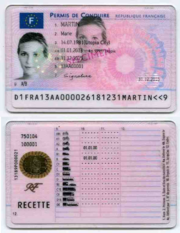
 Austria | 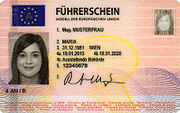 | 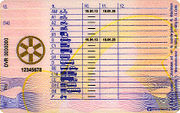 | xi February 2014 | ||
 Belgium |  |  | 27 December 2019 | ||
 Bulgaria | Link to image | 19 January 2013 | |||
 Croatia | 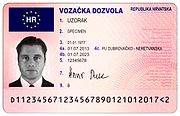 |  | 1 July /2013 | ||
 Cyprus | Link to prototype | 29 June 2015 | |||
 Czech Republic | Link to paradigm | 19 January 2013 | |||
 Denmark | Link to paradigm | 1 September 2017 | |||
 Estonia | Link to image | 19 Jan 2013 | |||
 Finland |  |  | Traficom | 1 April 2019 | |
 French republic | | | 1 July /2015 | ||
 Germany |  |  | xix January 2013 | ||
 Hellenic republic |  | 19 January 2013 | |||
 Hungary | Link to image | 19 January 2013 | |||
 Iceland | Link to image | three June 2013 | |||
 Republic of ireland | 19 January 2013 | ||||
 Italy |  |  | 19 Jan 2013 | ||
 Latvia | Link to paradigm | two January 2013 | |||
 Liechtenstein | i April 2019 | ||||
 Lithuania | Link to prototype | 24 November 2016 | |||
 Luxembourg |  | 19 January 2013 | |||
 Malta | |||||
 Netherlands | Link to image | 14 Nov 2014 | |||
 Norway |  |  | 15 years | Norwegian Public Roads Administration | 1 September 2018 |
 Poland | | | 4 March 2019 | ||
 Portugal | Link to image | 2 Jan 2013 | |||
 Romania |  |  | 19 January 2013 | ||
 Slovakia | Link to image | 15 September 2015 | |||
 Slovenia | Link to prototype | 19 January 2013 | |||
 Spain | Link to image | Link to prototype | 19 January 2013 | ||
 Sweden | Link to image | 10 years(5 years for C1, C1E, C, CE, D1, D1E, D, or DE) | Swedish Transport Agency | 21 January 2016 |

See also [edit]
- Driving licence
- European Commissioner for Transport
- European Wellness Insurance Carte du jour
- European identity card
- International Driving Permit
- Vehicle registration plates of Europe
- Prawo Jazdy (declared criminal) - supposed Shine national with numerous traffic violations in Republic of ireland, construed from misreading the Smooth driver's license
Notes [edit]
- ^ The legal acquis is marked as EEA-relevant by the EU, and is incorporated into the EEA Agreement (by Iceland, Liechtenstein and Kingdom of norway).
References [edit]
- ^ a b c "Driving licence recognition and validity". Europa.eu . Retrieved 27 Dec 2018.
- ^ Decision of the EEA Joint Committee No 7/94 of 21 March 1994 amending Protocol 47 and certain Annexes to the EEA Agreement, 28 June 1994, archived from the original on twenty December 2021, retrieved 15 March 2021
- ^ European Commission website – Ship: driving licence Archived 7 Feb 2009 at the Wayback Machine
- ^ "Consolidated version of Directive 91/439/EEC as of 18 July 2008". europa.eu.
- ^ "Klartecken för EU-körkort". Svenska Dagbladet. Archived from the original on 11 October 2006. Retrieved 27 March 2006.
- ^ "European union backs European driving licence". BBC News. 27 March 2006. Retrieved two May 2010.
- ^ "European union announces plans for European driving license". Workpermit.com. 18 December 2006.
- ^ "DIRECTIVE 2006/126/EC OF THE EUROPEAN PARLIAMENT AND OF THE COUNCIL". Official Journal of the European Union. thirty Dec 2006.
- ^ "303795 | European Free Merchandise Association". www.efta.int . Retrieved 9 March 2021.
- ^ a b "DECISION OF THE EEA JOINT COMMITTEE No 29/2008 of 14 March 2008 amending Annex XIII (Transport) to the EEA Agreement" (PDF). European Complimentary Trade Clan (EFTA).
- ^ Asa Bennett (27 January 2020). "How volition the Brexit transition period piece of work?". Telegraph. Archived from the original on 28 Jan 2020. Retrieved 30 January 2020.
- ^ "You can drive any type of vehicle listed on your full and valid licence – Driving in Great United kingdom on a non-GB licence – GOV.United kingdom". world wide web.gov.uk . Retrieved 13 March 2021.
- ^ "Exchanging your foreign driving licence". nidirect. 25 November 2015. Archived from the original on 6 May 2021. Retrieved 29 March 2021.
- ^ "Driving in the Eu from 1 January 2021: United kingdom of great britain and northern ireland licence holders living in the Eu". GOV.UK. Archived from the original on 30 Jan 2020. Retrieved 30 January 2020.
- ^ "Brexit: What are the rules on driving in the EU later transition?". BBC News. 27 December 2020. Archived from the original on 17 July 2020. Retrieved 29 December 2020.
- ^ "Visit Europe from 1 January 2021". GOV.UK. Archived from the original on 30 December 2020. Retrieved 29 Dec 2020.
- ^ "Brexit: What are the rules on driving in the Eu?". BBC News. 8 July 2021. Archived from the original on twenty December 2021. Retrieved 22 June 2020.
- ^ Directive 2006/126/EC of the European Parliament and of the Council of twenty December 2006 on driving licences
- ^ "Nytt norsk førerkort : fra 19. januar 2013" (PDF). Vegvesen.no . Retrieved 27 Dec 2018.
- ^ "Föreskrifter om ändring i Transportstyrelsens föreskrifter (TSFS 2012:sixty) om körkortets utformning och innehåll" (PDF). Transportstyrelsen.se. Archived (PDF) from the original on vi September 2017. Retrieved 27 December 2018.
- ^ "DIRECTIVE 2006/126/EC OF THE EUROPEAN PARLIAMENT AND OF THE Quango" (PDF). Official Journal of the European Matrimony. Archived (PDF) from the original on 11 May 2013. Retrieved 22 Jan 2013.
- ^ "asa-ausweise.ch". 27 August 2012. Archived from the original on 27 August 2012.
- ^ "Press Release: Changes to the Minimum Ages and Test Requirements to obtain a Driving Licence". Ship Malta. Archived from the original on 27 February 2015. Retrieved ii December 2014.
- ^ Ministerie van Algemene Zaken (30 July 2012). "Wanneer mag ik op een trike rijden?". Rijksoverheid.nl.
- ^ "Printing Release: Changes to the Minimum Ages and Exam Requirements to obtain a Driving Licence". Transport Malta. Archived from the original on 27 February 2015. Retrieved 2 December 2014.
- ^ "Kørekort til 17-årige (Ledsagerordningen)". Sikkertrafik.dk. Archived from the original on 2 January 2017. Retrieved ten January 2017.
- ^ "INF30 – Requirements for towing trailers in Bully United kingdom – GOV.UK" (PDF). Archived from the original (PDF) on 24 October 2013.
- ^ "Hva kan du kjøre med førerkort klasse S?". Statens vegvesen (in Norwegian Bokmål). Retrieved 10 March 2021.
- ^ "Ist Begleitetes Fahren mit 17 im Ausland erlaubt?". Focus.de. Archived from the original on twenty January 2016. Retrieved xx Jan 2015.
- ^ a b c d e "L17 – Allgemeines (SDG)". oesterreich.gv.at - Österreichs digitales Amt (in German). Retrieved 9 September 2021.
External links [edit]
- "Eu announces plans for European driving license". Workpermit.com. xviii December 2006. Retrieved 27 Dec 2018.
- "Eu driving licence coming in 2013". News.bbc.co.uk. xiv December 2006. Retrieved 27 December 2018.
- "Vehicles you tin can drive". Gov.uk . Retrieved 27 Dec 2018.
Source: https://en.wikipedia.org/wiki/European_driving_licence
0 Response to "What is the European counterpart to a T1 line"
Post a Comment